My Wine Experiment
Posted on February 9, 2010
Filed Under Technology | 1 Comment
I enjoy wine. But being a graduate of FPU I’m a cheapskate at heart. It’s particularly disheartening to spend my hard earned dollars on an untried bottle and then be disappointed. This means that—given the vast world of wine out there—I tend to be unadventurous and stick with the familiar… boring!
Some recent reading about a relatively new company called First Flavor has prompted me to embark on a simple experiment. First Flavor manufactures taste strips for consumer products in an effort to give customers a point-of-purchase opportunity to taste their clients’ wares. Rum, vodka, tequila, smoothies, fruit drinks, and toothpaste taste strips are among their offerings… why not wine?
Aficionados will laugh at the notion that the subtle characteristics of fine wine will translate to a paper (or other edible substrate) you pop in your mouth. Probably, but to an engineer it is certainly worthy of a quick and dirty experiment. My first stop was a research article on brain response to odor and taste, which gives a little insight into preparing such strips. Next I need to find edible paper for the substrate… hmm, do I have to order rice paper from China? Instead I try the next best thing, and sure enough, I can order edible paper from Amazon! (Books, DVDs, iPods, and edible paper… makes perfect sense to me.)
 Now the wine. Well it turns out I have a cousin in California who is one of the state’s premier growers of hard-to-find Iberian (mainly Portuguese) wine grapes. Ron, if you are reading this air freight a case of Alta Mesa Verdelho and Tempranillo ASAP… it’s tax deductible as an R&D expense. After preparing some taste strips and checking them against the real thing (eat a taste strip drink a case, eat another taste strip drink another case, etc.) I’ll report back. Stay tuned. – Dennis Owen
Comments
Robots Gaining in ‘Muscles,’ Dexterity
Posted on February 9, 2010
Filed Under Technology | 1 Comment
They’re not yet Captain Marvel but, by gosh, they’re getting close, at least in their upper bodies. New industrial robots being developed jointly by NASA and General Motors have amazing dexterity in their arms and even their fingers.
NASA and GM are working together on this next generation of robots because they have applications both for exploring space and building cars. They’re called Robonaut 2, or R2. The original Robonaut is 10 years old now.
 R2 looks almost musclebound. It can lift 20 pounds with each arm, “about four times that of other humanoid robots,” says NASA. Robots have long been used in the auto industry, of course. Perhaps at some point Robonaut 2 could be introduced to Ford’s RUTH, which does interior work on Ford vehicles, but so far without having a humanoid look. I wonder what that mating might yield?
R2’s “legs” at this point may be only a pedestal. But who knows about future generations and what their builders might need in terms of robotic assistance – like hiking on the moon or mars.
Robonaut is an impressive contrast to some earlier industrial robots of which we have first- hand knowledge. In the 1980s and ’90s we were involved in the recovery program for the Three Mile Island Unit 2 nuclear power plant after the 1979 accident there. Several robots were developed to deal with cleanup and disassembly tasks in high radiation areas unsafe for human work. Most of those were designed and built at the Robitics Institute at Cernegie Mellon University under the direction of the brilliant William (Red) Whittaker, or at his spinoff company RedZone Robotics. By today’s standards they were rather primitive beasts (see photo nearby).  Some were quite successful (reactor internals disassembly) while others were largely expensive failures (removing radioactive sludge from the reactor building basement).
Nonetheless, these and thousands of others are all part of the robot lineage that have taken us to Robonaut 2, RUTH, and more. Like the Apollo astronauts, when Robonaut’s descendants walk on Mars, we wonder if they will use their telescopic vision to look at a pinpoint of light in the heavens and dream of home. – Doug Bedell
Comments
Suppose Your Were the Last of Your Kind
Posted on February 5, 2010
Filed Under Business | Leave a Comment
Picture yourself as the last living representative of your craft or business. What state would you want to leave them in for whomever else might be interested in your life’s role?
Such epochal thoughts occurred to us in reading about the passing of Boa Sr in the Andaman Islands, the last living member of one of the world’s oldest tribal cultures.
Where are the Andaman Islands? They’re out in the Bay of Bengal, not too far from India, which governs them. But no matter where Boa Sr, or you, were or are located, the idea of being the last living representative of a culture stirs us.
 Boa Sr lived through a tsunami and the Japanese occupation of her homeland and was the last native in her island chain who was fluent in Bo, a 65,000-year-old. originally Neolithic (New Stone Age) culture. For several years until she died recently, she had no one else to speak her native language to. (Bo is one of 10 Great Adamanese languages.)
So, you may ask, suppose we were the last living representatives of our culture, craft or way of life? What imprint would we be leaving on history’s parchment? An idle question? Not at all. For we will be leaving a recollection of who we were, and how we dealt with others, among our friends and associates, at least.
There’s something especially poignant about noting the passing of Boa Sr, for she was the last of an entire culture. Until roads were built in the 1970s, her Adamanese people resisted colonizers and missionaries from the forests of their homeland. We don’t live in forests, but what culture, what accomplishments, what imprint are we creating for posterity to recall?
Boa Sr’s death reminds us that this isn’t a playful question. It’s a cultural one, involving the culture that we’re creating and, one day, will be leaving, too. Like Boa Sr, we are all, in our own settings, aspects of a creation that keeps passing and recreating itself. With other players, or maybe none. – Doug Bedell
Comments
Evolutionary Superiority
Posted on February 4, 2010
Filed Under Business | 2 Comments
Evolutionary Superiority, now that’s a powerful phrase… wouldn’t it make you feel puffed up to be able to apply that description to yourself? My friend, colleague, and fellow Insights blogger, Doug Bedell, has found some primate research from Harvard University that suggests that if you have one of the more annoying human traits—grumpiness—then you may qualify as evolutionarily superior.
The details are here, but basically the idea is that ape species that can set aside their natural tendency for playfulness now and again and get pissed off about something (chimpanzees) are more civilized and accomplished than their always playful peers (bonobos). I have to say I’m skeptical about applying this research to human evolution, but I’ve seen first hand how this research applies to life in the business world.
In large, hierarchical, and highly structured organizations I’ve worked with (think government agencies), too many workers go along to get along, and consequently things (processes, systems, rules, databases, paperwork, whatever) evolve slowly, if at all. It takes the rare grumpy man or woman (read that as annoyed, impatient, and “I’m mad as hell and I’m not going to take this anymore”*) to force change and make the organization evolve in some small way. I contrast that with some of the more  sharp, nimble, and evolve-or-die companies I’ve written for, which seem to be full of impatient and grumpy (but not uncivilized) people who are frequently unsatisfied and want things changed… now!.
The next time a colleague annoys you with a stubborn, grumpy, and get-with-the-program attitude, give him or her a hug (to hell with political correctness and harassment policies). They may be saving your career. – Dennis Owen
* Thanks to dailymotion.com
Comments
Continuity of Desires, If Not Means
Posted on February 1, 2010
Filed Under Technology | Leave a Comment
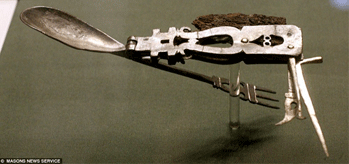 The Romans could never have imagined, nearly 2,000 years ago, that one day one of their gadgets would be featured on Twitter. But there it is – tweets and retweets on “The World’s Oldest Swiss Army Knife” have been frequent of late.
The gadget in question, which looks for all the world like an early prototype Swiss Army Knife as turned out, say, around the dawn of the 20th century, is a Roman eating tool, circa 200 A.D., with a fork, spoon, toothpick and a few other dining implements, all of which could be folded away.
Thus we have an example of continuity, not so much of a given implement, but of human interest in terms of functions – like eating – and a desire to make them easier or more convenient to handle. That’s the origin of technological progress, then and now.
Felt need stirs ingenuity and breeds technological advance. And our needs, seemingly, haven’t been so different over the centuries. (Though the Romans probably couldn’t have envisioned the ability to watch images move in a box.) As knowledge has piled up, we’ve gotten a lot more able to satisfy our yearnings – for better or worse.
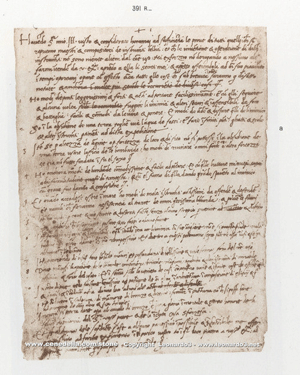 On the same Gizmodo Web page is another example of continuity – a job-hunter’s resumé. Only this job-hunter was Leonardo da Vinci.
Leonardo needed a resumé? Apparently so. “Most illustrious Lord…,” he began (we wouldn’t sound so fawning today), “I shall endeavor, without prejudice to any one else, to explain myself to your Excellency…” The painter of the Mona Lisa and The Last Supper went on (in handwriting, of course) to describe a virtual arsenal he had developed – with implements and attack-resistant vessels for use on land or sea, starting with “extremely light and strong bridges, adapted to be most easily carried…”
We trust the Duke of Milan, the lord Da Vinci was trying to impress, hired him. The Duke, of course, would have been well-served. Would that we could do as well building up a storehouse of contemporary technology, but for peaceful uses, of course. – Doug Bedell
Comments
‘No Thank You’
Posted on January 29, 2010
Filed Under The Writing Life | Leave a Comment
I’ve been a contract technical writer for over 20 years, so I’m used to the ebb and flow of new clients and new projects. I say that, but I have to acknowledge the rumbling in the gut that arises when the phone isn’t ringing and the email in-box contains little more than the Viagra solicitations that made it past the spam filter.
Those dry spells suddenly loom large as you forget all the interesting and lucrative projects you’ve enjoyed, and instead watch the number in the lower right corner of the corporation’s QuickBooks Cash Account ledger drift downward. It’s usually about that time, with prospects looking dim, that the phone rings and you hear something like the following:
• “My Master’s thesis is due at the end of the month and I need some writing and editing help.”
• “Do you do resumes?”
• “I’ve finished the first few chapters of my book and I think I need an editor.”
• “I need help with my business plan… uh, my budget is tight so can I pay part now and the balance when I land my start-up funding?’
Your mind instantly does the calculation. What the hell, I’m not very busy. This guy surely can’t pay my hourly rate, but if I cut the rate he might go for it, and at least I’d be billing a little. Yes, my last writing project was a six-month stint at GE writing about laser-induced isotope separation, and while this guy’s project isn’t technical I’d be helping someone… and remember, even Steve Jobs needed startup help at some point.
I laugh (no make that shudder) now when I think about how many times I went down that path early in my career. Only once, as I’ll explain below, have those calls ever been worth the ensuing headaches of handholding and 60 day late payments. Now when those calls come in I say “No thank you” but in my own way. I hear out the caller and ask a few questions. I explain that my business is highly technical writing and then I tell them my hourly rate. Most promise to think about it and call back. Knowing they won’t, I also turn to my list of local novice writers and resume services and offer a few names. I’m invariably polite and thank them for contacting ENCORE (Christian kindness is free and maybe they’ll remember me when that crazy business plan lands VC funding).
The one time it worked? A woman called in the middle of a very bad dry spell wanting help writing an award acceptance speech she had to make at a national fraternal organization’s convention. We went through the usual conversation and she promised to think about it and call back, and darned if the next day she did. I interviewed her for the speech, and over coffee in her living room I met a wonderful, kind, and accomplished woman. I prepared the draft, we tweaked it together, I emailed her the final, and I had a check two days later. She called to say the speech was a success, and son of a gun if she didn’t call me two months later to write another.
You’re a technical writer. Stick to your knitting and learn to say “No thank you.” But be alert for that rare and delightful exception to the rule. – Dennis Owen
Comments
‘High-Speed’ Trains Coming for the U.S., Finally
Posted on January 28, 2010
Filed Under Technology | Leave a Comment
We’ve been enjoying Wired’s spread on bullet trains finally (emphasis added) coming to the U.S. Yes, the historical tablet accompanying the Wired pieces shows that Japan introduced a 130 mph train in 1964, France a 161.6 mph one in 1981, China a 267 mph train in 2004 and France, again, a big-wheeled train capable of 357 mph in 2007.
We’ve long needed a fast, low-hassle alternative to airline travel. We’ve be waiting so long, on fact, one might think the airlines have been responsible for railroad planning and promotion. (At the current speeds they do travel, though, AMTRAK’s trains aren’t bad. We went coast-to-coast and back on a couple last year. Very pleasant, and no pat-downs.)
The St. Petersburg Times story reporting on President O’Bama’s visit to Tampa today to announce $1.25 billion in federal funding for a high-speed rail line there advises on the byplay between the President, Vice President Joe Biden and the Florida crowds, but doesn’t say how fast the “high-speed” trains are expected to run. That’s part of the problem – our personality-based, politically powered culture tends to shun specifics of technology – even big-time concepts like high-speed rail get shunted aside in the clamor.
Wired says the Tampa-Orlando trains are supposed to run at 180 m.p.h. We hope they do. – Doug Bedell

Wired illustration by Paul Rogers
Comments
The Vacation of Technical Writing
Posted on January 28, 2010
Filed Under The Writing Life | Leave a Comment
Wipe that smug look off your face… you didn’t catch this technical writer misspelling “Vocation.” The word “Vacation” is intentional and entirely appropriate.
As a contract technical writer I have traveled a lot. It’s one of the perks of what I do. It’s less hard on the family now that the children are grown, so I tend to do more of it and in fact I seek out interesting assignments in interesting places.
I have some wonderful memories of my writing “vacations.” I’ve prowled an amazing used book store a few miles from Texas A&M University. I’ve partied at a Moscow restaurant with Russian engineers watching barely-clad showgirls through a vodka-induced haze. I’ve returned from a “hard” day of writing and walked to a lake a hundred feet from the front door of my apartment in Virginia and fly fished for bass until it was too dark to see the fly. I’ve called my wife from the beach in La Jolla to tell her it is 70 degrees and the skies are blue, and she’s told me it’s twenty below, the pipes are frozen, and maybe it would be a good idea for me to get my ass home. I’ve worked on the set of a simulated nuclear plant control room on a sound stage in Pittsburgh—surrounded by the set of Mister Roger’s Neighborhood—making last-minute edits to a videotape script. I’ve been welcomed like a long-lost relative by the hospitable folks at a Virginia church. During the last few years of my father’s life, when my work took me to the San Francisco Bay Area, I’d stay with him in my childhood home and we’d just talk the evening away. And my wife and I have turned writing assignments into real vacations; a week in Vienna, a warm mid-winter stay in Florida, and more.
Even the writing projects close to home are vacations. Invariably, you make new friends, learn about new (to you) technologies, lunch at new restaurants with your colleagues, and generally expand your horizons.
Do you write? If so, you are a lucky man or woman… count your blessings and enjoy your vacations. – Dennis Owen
Comments
China’s Shadow Behind a U.S. Electric Car
Posted on January 22, 2010
Filed Under Technology | Leave a Comment
We’ve been waiting for electric cars to start making an appearance on U.S. highways – not hybrids but full-out electric models. Chevrolet’s much-anticipated Volt is now scheduled for launching in November. It will run 40 miles on an electric charge and, says Chevy, “uses a range-extending gas generator that produces enough energy to power it for hundreds of miles on a single tank of gas.” What that’s referring to, explains Wikipedia’s article on the Volt, is “a small 4-cylinder gasoline internal combustion engine (that) creates electricity on-board using a 53 kW (71 hp) generator to extend the Volt’s range to more than 300 miles (483 km).”
Volts are scheduled for only 10,000 cars in 2011 – their introductory year – and maybe 60,000 in 2012. And the price is estimated to be near $40,000, before any federal tax credits applicable by then. So that’s low output and a high price, for starters anyway, on a U.S. electric car.
We were nonetheless encouraged by a Wall Street Journal blog post in December on a joint-venture between A123 Systems, a Massachusetts-based battery company, and SAIC (Shanghai Automotive Industry Corporation), “China’s biggest auto-maker by volume which already has a couple (electric cars) in the pipeline.”
A123, a maker of lithium ion batteries, seemed to have lost its electric car prospects when Chrysler dropped its plans for one. So the Chinese deal has given the U.S. company a boost, and least for now.
But the Journal notes there are other interests aiming for electric cars – “local (U.S.) rivals backed by Warren Buffet, playing the same game.” The technology is either so vexing to producers, or perplexing to car buyers, that lots of folks seem to be wishing there wasn’t a need for it. But there is.
Even so, oil prices are probably going to have to rise again, and stay higher, for us to get serious about getting electric cars on U.S. roads. As in so many other areas, though, the Chinese may provide a push. – Doug Bedell

The Chevrolet Volt
Comments
Diving Deep to View Creatures that Vanish Before Your Eyes
Posted on January 19, 2010
Filed Under Technology | Leave a Comment
Picture yourself in total darkness, with streaks of flourescent light darting across the dark or suggestive of bigger, slower moving creatures. In this instance, you’ll be deep in the ocean, fortunate to have David Gallo as your guide on a deep-sea dive.
Gallo was trained as a geologist but he’s an acclaimed oceanographer now. On this TED.com video he narrates – at a screen in a lecture hall – a dive into regions where undersea creatures have an amazing capability to camouflage themselves to hide from predators like barracudas. Changing color and texture, the wiley creatures fade into plant or rock clusters in a manner that makes them disappear before your eyes. The audience in Gallo’s lecture hall gasps and applauds – it can’t help but respond in wonder.
The florescence is explained as “bioluminescence,” a term that almost does justice to the softly glowing appearance of these dwellers in the deep. Photographed with Dr. Edith Witter’s undersea camera, there are fish with pulsating eyes and pinwheel bodies – a truly astonishing display of solitary ocean creatures. You realize that they have no idea of what they’re missing in an “atmosphere” of water, and you wonder, what may we be missing in our own airy environment.
Go on this all too brief tour with Gallo, it’s a marvel of undersea photography and knowledgeable narration. If your life or business revolves around high-tech, watching this video should make you humble: whatever you do, it pales in comparison to nature’s technology.
Gallo works as an undersea explorer, sometimes in partnership with Titanic-hunter Robert Ballard, and travels on behalf of the Woods Hole laboratories to explain how the oceans are being mapped in “unprecedented clarity and detail.” – Doug Bedell

David Gallo
Comments


Recently
- Presentations With Forethought
- Technical Writing’s Lineage – Surely It’s Deeper than Digital
- At the Holidays, Twitting Amazon
- Successful Cookie Baking – From Mom, an Acknowledged Expert
- Slides for a Tech Writer’s Craft
- Digital or Not, Be Clear
- Being Watchful About Digital Designs…
- When Proposals Don’t Click, Keep Making Them Anyway
- Like a Good Gardener, Help an Enterprise Keep Itself Current
- We’re Leaders All, And Need to Think That Way
Categories
Archives
- January 2017
- December 2016
- November 2016
- October 2016
- September 2016
- August 2016
- July 2016
- June 2016
- May 2016
- April 2016
- March 2016
- February 2016
- January 2016
- December 2015
- November 2015
- October 2015
- September 2015
- August 2015
- July 2015
- June 2015
- May 2015
- April 2015
- March 2015
- February 2015
- January 2015
- December 2014
- November 2014
- October 2014
- March 2014
- February 2014
- January 2014
- December 2013
- November 2013
- October 2013
- September 2013
- August 2013
- July 2013
- June 2013
- May 2013
- April 2013
- March 2013
- February 2013
- January 2013
- December 2012
- November 2012
- October 2012
- September 2012
- August 2012
- July 2012
- June 2012
- May 2012
- April 2012
- March 2012
- February 2012
- January 2012
- December 2011
- November 2011
- October 2011
- September 2011
- August 2011
- July 2011
- June 2011
- May 2011
- April 2011
- March 2011
- February 2011
- January 2011
- December 2010
- November 2010
- October 2010
- September 2010
- August 2010
- July 2010
- June 2010
- May 2010
- April 2010
- March 2010
- February 2010
- January 2010
Blogroll