Ralph Lauren’s Alternative Reality
Posted on November 12, 2010
Filed Under Business, The Writing Life | Leave a Comment
Wd don’t attempt to keep up with events in the fashion world, but when one of those events incorporates advances in visual technology – fusing movies, 3D projection and fashion – it gets our attention. That’s what Ralph Lauren’s “4D” shows did this week at their New York and London stores. Read more
Comments
A Soaring Energy Refit
Posted on November 8, 2010
Filed Under Technology | Leave a Comment
We’ve been on a high recently, writing about rooftop power plants, “invisible” airplanes and “skylifter” flying saucers. But here’s one more – New York’s iconic Empire State Building, now 80 years old, is finishing up an energy-saving windows upgrade.
Yes, all of the Empire State Building’s 6,500 windows are being enhanced with an energy-saving film and inert gas being added between their double panes, at the rate of 50 windows a night. Read more
Comments
Rooftop Power Plants, Sprayed Onto Steel Plates
Posted on October 29, 2010
Filed Under Technology | Leave a Comment
While Dennis Owen is working in nuclear power, we need to get a word in for solar power as it’s being envisioned in Great Britain, rooftop by rooftop. We don’t mean in the form of “conventional” solar panels, but, rather, sheet steel panels sprayed with solar cells. Read more
Comments
Airbus’ Invisible Airplanes…
Posted on October 12, 2010
Filed Under Technology | Leave a Comment
Oh, boy, it’s been a wondrous evening on the Internet. First, Google is developing driverless cars. And now we find that Airbus is anticipating building invisible airplanes. The aircraft manufacturer, Fox News reports, envisions airliners with transparent fuselages. That is, they would become transparent when the pilot pushes a button Read more
Comments
… and Google’s Self-Driving Cars
Posted on October 12, 2010
Filed Under Technology | Leave a Comment
It won’t be available anytime soon, but in the foreseeable future you might be a passenger in a Google-driven car. That’s right – Google engineers announced over the weekend that they have already logged 140,000 miles on seven test cars that can drive themselves, apparently safely and soundly. Read more
Comments
Verizon Moving to 4G Wireless Speeds
Posted on October 10, 2010
Filed Under Technology | Leave a Comment
 Verizon, reports Government Technology, is about to start upgrading its wireless network to 4G speeds. This is a bit of utilitarian good news for first responders, engineers and others who move large files on their wireless devices. Read more
Comments
Skylifter Looks Like a Flying ‘Skittle’
Posted on October 3, 2010
Filed Under Business, Technology | Leave a Comment
The other day, just up the rural road from where we live, a truck with an oversized load – maybe the cylinder of a farmer’s new silo – was announced by the flashing lights of its escort truck. It was touch-and-go as the truck and its load turned the tight corner. We pictured the convoy in all the antsy scrapes it would be in that day and wondered, mightn’t there a better way to transport oversized loads that are too heavy for helicopters?
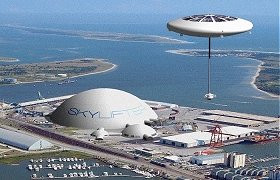 From Australia comes a hopeful “Yes!” The Aussie aeronautical company Skylifter has come up with a variation of a balloon – an inflatable flying saucer – that in three years or so it expects to be flying heavy equipment, even whole buildings, to remote areas. Heavy transport helicopters can lift “only” 20 tons. The Skylifter is envisioned to haul as much as 150 tons, a 700 percent increase, reports Popular Science. With its thinner profile, the “saucer” should be less susceptible to winds during flight. It’s expected to have a range of 1240 miles. The control pod, or aerostat, hangs below the “saucer” on what seems like a pole and has propellers for steering the aircraft. All-in-all from a distance, the Skylifter will probably look something like a child’s skittles top.
 From the gallery of photos that Skylifter provides, the Skylifter looks like it could be transporting welcome loads to exotic places, even a whole “hotel.” The Skylifter has obvious implications for nuclear power plant construction or refurbishment. Imagine not having to haul, say, new steam generators across the countryside.
Dirigibles have been another much-anticipated flying freight solution, so the Skylifter may have competition for lighter-than-air heavy lifting. – Doug Bedell
Comments
Wind Power on Delaware’s Shore
Posted on September 26, 2010
Filed Under Technology | Leave a Comment
We were struck by a new feature on the horizon as we spent our annual weekend at Lewes, Delaware, this month. There’s now a 400-foot-tall wind turbine across the harbor on the Lewes campus of the University of Delaware. It rises above the tree line, its blades turning lazily in the seaside breeze, a source of alternative energy.
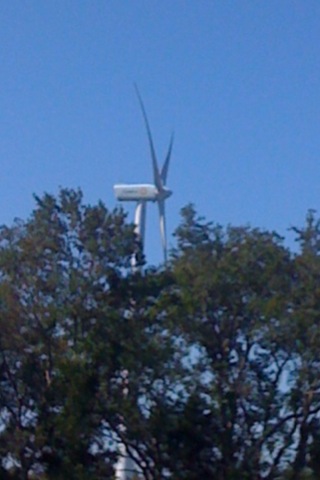 The Lewes wind turbine, which became operational on June 11, generates two megawatts of electricity. That’s enough to power 500 homes or the entire Lewes campus, with enough left over for occasional export to the regional grid. I’m used to roaring turbine- generators and have wondered how a wind turbine’s slowly turning blades (144-feet-long in this instance) accomplish the generation of this much power.
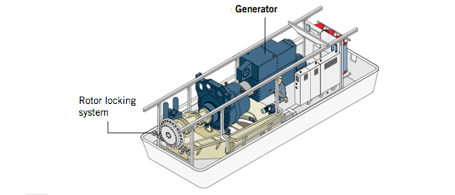
A website provided by Gamesa Technology Corp., the turbine’s manufacturer, explains that there’s a gearbox that steps up the rotation to match that of turbine-generators on the grid. The turbine’s nose can also be rotated to keep it pointed into the wind. Should there be too much wind, it can be shut down.
 Gamesa is a Spanish company, but the Lewes turbine was manufactured at Gamesa’s plant at Ebensburg, Pa. It’s an experience, we discovered in another context, to drive past a tractor-trailer towing a turbine blade to a tower’s construction site. “What’s that?”, you wonder, if you don’t already know.
Currently, I learned from Wikipedia, the largest-capacity wind turbine, the EnerconE-126, has a rated capacity of 7.58 megawatts and an overall height of 650 feet. But “at least four companies – American Superconductor, Wind Power Ltd., Clipper Windpower and Sway – are working on the development of a 10 megawatt turbine.”
Blow on, ye winds of energy progress! – Doug Bedell
Comments
Ford Debuts An Electric Focus
Posted on September 16, 2010
Filed Under Business, Technology | Leave a Comment
This isn’t an electric car blog, but we’ve been following developments toward diversified transportation because we truly need to shake up our transportation system. Today Ford announced an electric Focus, a car with special appeal to us, because we own a gasoline-powered model and love it.
 The thing is, though, Ford announced the car in partnership with the Texas utility, Oncor. And that immediately illustrated a limitation of all-electric vehicles. Iris Kuo, the GreenBeat reviewer, reached to turn on the air conditioning and Ford’s representative in the car asked her to turn it back off. Reason: the A/C drains the battery too much. But they couldn’t figure out how to shut it off “thanks to a confusing control panel.”
So there goes the Texas market, where temperatures are high and distances long. Ah well, it’s no doubt a lovely car for other, more temperate locales. (It should be available next year.)
Oncor has installed 1.2 million smart meters, which will help consumers decide when rates are lowest for charging electric vehicles. Texas at least has lots of energy reserves.
Buyers of the first all-electric cars are going to be a little like modern-day pioneers, figuring out what the best blend of charging and mileage might be. Sort of like how far horses could pull before they got too hungry and fatigued. There’s also a need to educate emergency responders about electrics, who could be endangered by the high battery voltage at the scene of an accident.
But this is important stuff, because our transportation system truly needs a broader mix of motive power. – Doug Bedell
Comments
900,000-For-All In Chinese Factory ‘Cities’
Posted on September 13, 2010
Filed Under Business, Technology | Leave a Comment
We’re feeling a little differently about using our iPhone and other electronic gadgets after reading the Bloomberg Businessweek profile of the Foxconn Corp. in China, which operates from city-sized factory campuses and has had to give special attention to preventing suicides among its 920,000-plus employees in mainland China.
Not that Foxconn’s working conditions, apparently, are all that dire. They’re not necessarily crushing, just concentrated, apparently with middle managers who aren’t sufficiently trained or adept at dealing with employees en masse.
 Terry Gou, Foxconn’s hard-charging founder and chairman, has been eating three meals a day at work and not getting a lot of sleep figuring how to keep the huge company growing while being more considerate of its employees at the same time. American firms like IBM, Cisco, Microsoft, Hewlett-Packard, Apple and Dell are wishing him well, for they are among Foxconn’s high-tech customers.
Gadgets come at a price, and the price is more than the figures on a sales slip. Consumers need to recognize that. Foxconn can concentrate efficiencies to produce electronic innards at highly advantageous prices, but consumers around the world should be rooting for it to become increasingly proficient at insuring the welfare of its armies of employees.
Chairman Gou seems to understand that installing suicide-prevention nets on Foxconn dormitories isn’t really the answer, though the nets were installed last May, Bloomberg Businessweek reports, after the ninth Foxconn worker jumped to his death this year, .
The pressures of obtaining enough raw materials and maximizing production in the face of brisk consumer demand – think of how effectively Steve Jobs revs up interest in Apple’s latest products, for instance – possibly haven’t allowed comparable attention to workplace issues. But Terry Gou seems intent on catching up there. Foxconn has launched a “Prevention-Reengineering Caring” program including “24-hour care centers staffed by certified counselors…and is teaching managers to be more attuned to workers’ emotional needs.”
“‘Yelling is not the only way,’ says Louis Woo, a 62-year-old Stanford graduate, whom Foxconn “picked to brief Bloomberg Businessweek on the company’s transformation into a more benign corporate citizen.”
Indeed not. Companies who sell tools for better, more efficient lives for consumers need to apply that same ingenuity to managing their workers well, as challenging an obligation as that may be. – Doug Bedell
Comments


Recently
- Presentations With Forethought
- Technical Writing’s Lineage – Surely It’s Deeper than Digital
- At the Holidays, Twitting Amazon
- Successful Cookie Baking – From Mom, an Acknowledged Expert
- Slides for a Tech Writer’s Craft
- Digital or Not, Be Clear
- Being Watchful About Digital Designs…
- When Proposals Don’t Click, Keep Making Them Anyway
- Like a Good Gardener, Help an Enterprise Keep Itself Current
- We’re Leaders All, And Need to Think That Way
Categories
Archives
- January 2017
- December 2016
- November 2016
- October 2016
- September 2016
- August 2016
- July 2016
- June 2016
- May 2016
- April 2016
- March 2016
- February 2016
- January 2016
- December 2015
- November 2015
- October 2015
- September 2015
- August 2015
- July 2015
- June 2015
- May 2015
- April 2015
- March 2015
- February 2015
- January 2015
- December 2014
- November 2014
- October 2014
- March 2014
- February 2014
- January 2014
- December 2013
- November 2013
- October 2013
- September 2013
- August 2013
- July 2013
- June 2013
- May 2013
- April 2013
- March 2013
- February 2013
- January 2013
- December 2012
- November 2012
- October 2012
- September 2012
- August 2012
- July 2012
- June 2012
- May 2012
- April 2012
- March 2012
- February 2012
- January 2012
- December 2011
- November 2011
- October 2011
- September 2011
- August 2011
- July 2011
- June 2011
- May 2011
- April 2011
- March 2011
- February 2011
- January 2011
- December 2010
- November 2010
- October 2010
- September 2010
- August 2010
- July 2010
- June 2010
- May 2010
- April 2010
- March 2010
- February 2010
- January 2010
Blogroll