A Green Brownfield… Now that’s an Idea Worth Pursuing!
Posted on March 16, 2010
Filed Under Business, Technology | Leave a Comment
Whenever engineers gather—particularly engineers whose hairlines are either receding or tinged with gray—the conversation often turns to the sad state of infrastructure renewal in this country. Those engineers recall the “old days” when either they or their fathers (sorry, very few female engineers in those days) worked on large projects that were actually conceived, approved, and built on budget and on schedule.
The contract for Hoover Dam was awarded in 1931 and the dam was dedicated in 1935, two years ahead of schedule and about $15,000,000 (30%) under budget. Imagine trying to obtain approval today for that project, or for the approximately 47,000 mile Interstate Highway System, a national treasure that accounts for about one-third of all miles Americans drive. Today we are hard-pressed to build a much needed power plant (green or not) or bridge, let alone something of real national significance (such as Yucca Mountain… billions spent for naught).
 Perhaps a new push by the EPA and DOE will help reverse this dreadful record, at least for some of the less controversial infrastructure projects. According to an Energybiz Insider article, those agencies are considering regulations to encourage renewable energy plants (solar, wind, and hydro) on brownfields, that is, contaminated and abandoned industrial sites. Every state has such sites, and they total about 450,000 acres in the U.S.
The article cites a few such success stories, including an abandoned steel mill in New York that is now home to a wind farm, and a U.S. Army facility in Colorado where solar electric panels have been installed. One hopes that even the hardcore NIMBYs might prefer a green energy power plant—however modest in output—to an abandoned, chemical-laden brownfield in their communities. Then again, if the chemical soup on the site caused algae to mutate into a deadly new life form I’m sure there would be intervenors carrying “Save the Scum” placards. — Dennis Owen
Comments
View Earth’s Climate Prudently
Posted on March 12, 2010
Filed Under Technology | Leave a Comment
The debate over climate change troubles me, especially now that the doubters seem to be gaining. But I don’t hold to the irritating “conclusion” reached by Bill Chameides, Dean of Duke University’s Nicholas School of the Environment and a member of the Natonal Academy of Sciences, who presents some of the latest poll findings on The Huffington Post.
Noting that “America has experienced a cool patch of late,” Chameides writes that “Some scientists have conjectured that it has something to do with the jet stream. But what do they know? I think it could be due to the Tea Party. With all their speechifying, finger-wagging, and chanting, they may have used up all of the nation’s hot air. ”
 That sounds pretty undeanly to me. The problem with climate change is that it’s a long-term trend, not immediately measurable in any conclusive way. And that sort of reassuring evidence seems to be what many of us want.
I write as a spring rain washes away the last of a huge pile of snow we’ve had out front for weeks now. We’ve had a rough winter here in Central Pennsylvania. But that, in itself, doesn’t say anything decisive about whether the climate is heating up or cooling down. We’ve got to be patient about scientific things.
More importantly, when a dispute involves the state of the entire planet and its atmosphere we have to err on the side of caution. That is, we should be acting as if the climate is heating up, even if we can’t be completely sure that it is. (Even though most scientists, apparently, would argue about that.) The risks if we do little or nothing and the scientific consensus is correct are just too great. Prudence matters more than emotions.
If we limit emissions of greenhouse gases, we have a cleaner environment, whether or not icebergs keep melting. That’s a plus we should all be willing to share in achieving.
I wrote the other day on another blog that monitoring climate research calls for “the most enlightened public relations project ever.” I suggested that a website like Solveclimate.com might be the answer. I didn’t know then about NOAA’s “State of the Climate” site, though it may not be focused enough.
I appreciate, however, Bill Chameides making me aware of the NOAA site. That’s the best we can do for all of us – make information available, think prudently and take steps to improve the quality of our environment, whatever Earth’s long-term fate may be. – Doug Bedell
Comments
NASA Needs New Rockets
Posted on March 9, 2010
Filed Under Technology | Leave a Comment
NASA exists to satisfy a national travel itch – we want to explore space and NASA’s rockets are the means of doing so. The problem is, there are only a few celestial destinations we’ll be able to reach in the next few decades. And NASA needs not so much a map as a method to get to them.
President Obama wants to develop better rocketry before heading off again to the moon, or to somewhere else reachable in space, perhaps an asteroid and, ultimately, Mars. Truly, this is a high technological challenge.
As The Washington Post recently reported, “future space flight, NASA officials say, now depends on new rocket science and where it can take us.”
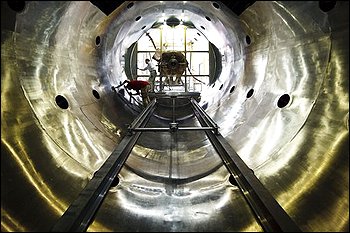 So NASA needs not to be wistful, but extra ingenious. Practicality never counted for so much in technological terms. If we’re going to venture further into space, we need better rockets. Our reach into space depends on getting better, ever more ingenious, technically.
Like the original moon program itself, space is challenging our technical genius. We reach new frontiers, now, by having better propulsion systems. If we don’t come up with them, we stay home.
Maybe we should stay home anyway, some will say. But the space program has always been a key means of technical progress, with developments in space exploration being adapted and dispersed for everyday use.
So good luck on those rockets, NASA, and anyone else who can help us explore the universe. We’re getting really itchy again for extraterrestrial travel.
– Doug Bedell
Comments
South From Alaska (Sarah’s Song)
Posted on March 2, 2010
Filed Under The Writing Life | 1 Comment
Sarah Palin…what thoughts does that name invoke? Obviously, that depends on your politics. But in a just world her name would invoke much more than an unthinking reaction based on her— and your — place on the political continuum. Politics aside, she should be respected for her quite remarkable accomplishments. Athlete (cross-country and Alaska state championship basketball team), beauty pageant winner, sports reporter (TV and print), city mayor, governor of Alaska (first woman and youngest at 42), candidate for vice president, best-selling author, television commentator, self-made millionaire. If you dismiss that record of accomplishment based on politics, it says much more about you than it does about her.
With these thoughts rolling around in my head, my iPod shuffle offered up Johnny Horton’s North to Alaska. So here, with apologies to Johnny, is:
South from Alaska
Sarah left Wasilla, with important work to do
The first woman and the youngest, state governor at forty-two
She traveled south to Juneau, to try things new and bold
She fought for all Alaskans
And her years up there were gold
Sarah crossed Alaska’s mountains, to St. Paul she was bound
With husband Todd and children, the newest face around
She spoke about her family, and the need to set things right
The hockey mom from Alaska, brought down the house that night
CHORUS
The country is fallin’
The people are callin’
South from Alaska
Go south to lead the charge
South from Alaska
Go south to lead the charge
This country needs a leader, who loves this blessed land
Who with heart and soul believes it is, the last best hope of man
Who will stand proud and proclaim it, over land and air and seas
Our principles are simple, and those principles are these
I am my brother’s keeper, you can leave that up to me
Those who seek to harm us, will soon the eagle see
The wealth of this great nation, must be in the people’s hands
There’s peace on earth before us, if one with God we’ll stand
CHORUS (end)
Well that’s my modest contribution to the Sarah Palin story. It is modest indeed, and there are a number of lines that are weak and just don’t click. Send me your markups (info@EncoreTechResources.com) and we’ll beef up the lyrics together (giving you credit of course), and Insights will publish our much improved version of Sarah’s song.
By the way, as pro-Palin as this posting sounds, I personally don’t think she should run. I see her role as a conservative gadfly, prodding the next Republican administration to hew to its libertarian principles. — Dennis Owen
Comments
Quality Requires Recall – Before Recalls
Posted on February 26, 2010
Filed Under Business | 2 Comments
Oh, my goodness. There was American statistician W. Edwards Deming addressing a group of Japanese industrialists in 1950, at the Mt. Hakone Conference Center, on the subject of statistical product quality administration, which had been introduced in the U.S. in the 1940s.
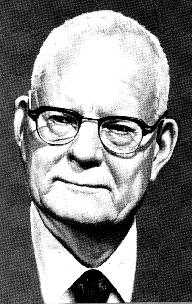 “The knowledge and brains applied to statistics by the Japanese are an essential national resource; it is important in the same way as water power, forests, and railroads,” Dr. Deming told his attentive listenders, “And that statistical knowledge, much like water power, is not useful at all unless it has an impact on work opportunity and work (itself).”
There’s more: “However, no matter how excellent your technicians, you who are leaders, must strive for advances in the improvement of product quality and uniformity if your technicians are to be able to make improvements. The first step, therefore, belongs with management,” Dr. Deming told those Japanese executives. “First, your company technicians and your factories must know that you have a fervor for advancing product quality and uniformity and a sense of responsibility for product quality.”
All the apologies we have been hearing from Toyota executives of late would not have been necessary if they had kept Dr. Deming’s words before them. It’s profoundly interesting that the quality movement that Dr. Deming’s 1950 lectures spurred in Japan did not take hold in the U.S. until the 1980s, when Dr. Deming had to be “discovered” by NBC television at his home in Bethesda, Md. By then, Japanese attention to quality was almost legendary, but it always depended, and continues to depend, on management’s commitment to its principles.
So, when you have James Treece, of Automotive News, a veteran Toyota observer, noting that “Toyota has a deep preference for secrecy rather than openness,” which produces “arrogance, complacency, and understaffing,” you realize the importance not only of initial learning, but of learning that’s continually reinforced by alert executive leadership.
Dr. Deming had been invited to Japan by General MacArthur to help with the 1951 Japanese census. He found Japanese business executives despairing that they would never be known for producing anything but junk. When he encountered some Japanese statisticians interested in promoting quality control, he rallied them. Next, their managers.
“In the last ten years,” Dr. Deming continued in his Mt. Hakone talk, “there has been no scientific method which has experienced such rapid expansion as has statistical theory. In the context of today’s Japan, the most useful thing for manufacturers could be nothing but the appropriate application of statistical techniques.”
The rest became Japanese and world industrial history – and dismay, when a company like Toyota overlooks quality’s grounding principles – awareness, persistence and honesty. (Such as trending consumer complaints of acceleration problems, and responding to them promptly.)
Quality principles don’t have to be reinvented; they have to be recalled and remembered. – Doug Bedell
Comments
My Shrinking World
Posted on February 23, 2010
Filed Under The Writing Life | Leave a Comment
Just a week or so ago I was thinking about some travel. I have friends in Missouri I haven’t seen in ages, and I’d really like to get back to Salt Lake City. I used to live a few hours away and I always enjoyed that city. With my current writing project wrapping up in a month or so and only some vague outlines of where the next one will be, it seemed like the perfect time for a road trip.
Then I spent a good chunk of last Saturday in the ER. Why is not important. Suffice it to say that until things get sorted out, alone on the road a thousand miles from home and loved ones seems suddenly less attractive.
I think about my situation and can’t help but draw some contrasts. My son is studying in Europe and as I write this he is between semesters and on a month-long adventure: Istanbul, Vienna, Berlin, Cologne, Dresden, Hamburg, Leipzig, and more. With my money and his rail pass, his world is very large indeed…thousands of miles. My mother died of Alzheimer’s disease, and in the last year of her life her world was measured in feet… a very few feet.
I intend to rage against my shrinking world. Bold talk from a guy who a few days ago was hoping to have the chance to make the two-mile trip back home. I wonder if I’ll have the courage to venture far from the illusory safety of a shrunken world? – Dennis Owen
Comments
Lost Jobs Aren’t Being Replaced
Posted on February 23, 2010
Filed Under Technology | 1 Comment
Truly ominous confirmation of our post on ebbing U.S. innovation comes from a New York Times article, “Millions of Unemployed Face Years Without Jobs.”
How is The Times able to deliver this news of the “new poor”? A consensus is developing among economists that the recovery from this recession “will leave more people behind than in past recessions, failing to create jobs in sufficient numbers to absorb the record-setting ranks of the long-term unemployed.”
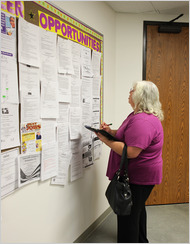 And that has much to do with the lagging U.S. rate of development in science and technology, along with turning technological thinking into new U.S.-based businesses and jobs.
There are now 6.3 million Americans who have been unemployed for six months or longer, “the largest number since the government began keeping track in 1948. That is more than double the toll in the next-worst period, in the early 1980s.”
Schools, colleges and workplaces that are unable to attract more young people into science and technology will see them, instead, waiting haplessly on unemployment lines. This is a truly frightening prospect, the dark side of the American dream when it falters.
“Every downturn,” notes The Times, “pushes some people out of the middle class before the economy resumes expanding. Most recover. Many prosper. But some economists worry that this time could be different. An unusual constellation of forces — some embedded in the modern-day economy, others unique to this wrenching recession — might make it especially difficult for those out of work to find their way back to their middle-class lives.”
We have exported job opportunities and are losing our technological edge against the countries where those jobs have gone. Truly a double whammy, unless we start thinking Sputnik-like and figure out how to do more technically-grounded work at home. We need a renewed job market, and it won’t come quickly. – Doug Bedell
Comments
U.S. Ebbing in Science and Engineering
Posted on February 22, 2010
Filed Under Technology | 1 Comment
Are we gaining or losing ground in science and engineering, key sources of innovation and that quintessential American ideal, progress? Either way, by how much?
Not easy to tell, you say? Nothing more than a hunch would be involved? Maybe so…unless you dig into the recently released Science and Engineering Indicators 2010. The National Science Board (NSB) – the governing body for the National Science Foundation (NSF) and NSF’s Division of Science resources Statistics – works this report up every two years.
 (We’re indebted to ThomasNet for bringing the NSF report to our attention on its Industry Market Trends (IMT) blog. IMT is a great place to keep abreast of trends in engineering – projects, education, funding and other key material.)
Unfortunately, the NSF report verifies that, what to many of us is a hunch, is actually a worrisome reality. “The latest edition indicates that while the state of U.S. science and engineering is strong, ‘U.S. dominance has eroded significantly’ in recent years, due in large part to rapidly increasing capabilities among Asian nations, particularly China, Kei Koizumi, assistant director for federal R&D in President Obama’s Office of Science and Technology Policy, said in an announcement of the findings.”
“‘The data begin to tell a worrisome story,'” Koizumi said.
The findings are listed in greater detail on the ThomasNet blog. But they include a declining U.S. share of R&D activity, lagging student interest in studying natural sciences and engineering, and impressive increases in entry-level natural sciences and engineering degrees in the developing world, including China (leading, of course).
From a U.S. perspective, the trends aren’t great, either, in science and engineering doctorates, research articles published and U.S. patents awarded to foreign inventors.
It does appear, though, that a “large proportion” of the foreign Ph.D. recipients at U.S. universities will stay here, if we keep encouraging them to do so. “Sixty percent of temporary visa holders who had earned a U.S. science and engineering Ph.D. in 1997 were gainfully employed in the U.S in 2007, the highest 10-year stay rate ever observed.”
We all have our own notions of what’s diverting American youngsters from the sciences and engineering– often, it seems, from concentrating notably anywhere at all. (Except, apparently, in Olympic sports.) But if the momentum that science and engineering give our economy is to pick up, educators, parents and employers need to become familiar with what’s occurring at U.S. schools and help them renew the appeal of rigorous subjects like math, science and engineering. – Doug Bedell
Comments
The Latest Airship Vision – an Elegant Floating Hotel
Posted on February 15, 2010
Filed Under Technology | 1 Comment
We’re still imagining new ways to float through the skies in airships. Korean Samsung Construction and Trading (Samsung C&T) is investing in the Seymourpowell Aircruise to further its interest in exotic materials.
Exotic this airship surely is – much more, for instance, than a dirigible with a cabin suspended below. “The initial design,” says a Seymourpowell.com release, “proposes a bar/lounge zone, four duplex apartments, a penthouse and five smaller apartments.” It would be a hotel in the skies, traveling leisurely across oceans or wherever its “residents” wanted to go.
 Whether it will ever be reach commercial scale is doubtful, says the MetalMiner blog. But dreams and visions don’t necessarily have to be scaled-up – the Aircruise already exists in this YouTube video. (The lovely accompanying music, alone, will transport you.)
There is something entirely peaceful and benign, if very expensive, about this craft, which would be lifted by hydrogen and powered by solar energy. The details are in the links included here. The vision, as always with visions, is what matters most. – Doug Bedell
Comments
What Toyota Apparently Forgot
Posted on February 11, 2010
Filed Under Business | Leave a Comment
Strange what gets in the way of cultural and business history and learning. In the 1980’s, Japan was the only overseas nation that took General Public Utilities (GPU) up on its offer to participate in the cleanup of Three Mile Island Unit 2 and learn from it. The Japanese impressed us at TMI as avid learners, a quality we assumed spread across their industrial culture.
Yet what has Toyota possibly overlooked about corporate risks? Not only some of the finer points of industrial quality control, it appears, but of crisis communication as well – factors that the Japanese engineers at TMI observed fairly closely.
 Remember that workers on a Japanese assembly line – gemba crews – can stop the line at will whenever they observe a quality lapse. But suppose the issue is more subtle, not readily apparent to production workers? Where was the engineering attentiveness to possible acceleration problems? And in crisis terms, why did it take Toyota months to acknowledge it had a safety problem it should have advised its customers about?
Writing for Business Week, Jeffrey Liker, an author of six books about Toyota, says concerns about its apparent quality lapses are overdone. We hope he’s right. Yet something is amiss when concerns over a corporation’s responsiveness balloon to the point of threatening its survival.
It’s not just the ability to take safety issues seriously at the highest levels that matters, but to act promptly and effectively on them once they’re recognized. No matter how vaunted an organization may be, sloppiness can creep in. Procedures to avoid that have to be maintained. Management needs always to be attentive and candid.
The 1979 accident at Three Mile Island Unit 2 wasn’t as threatening to the public as it was initially perceived, either. Yet, because of the ineffective manner in which it was experienced and communicated in its early stages, the Unit 2 accident caused a lack of confidence that produced a 30-year U.S. nuclear power stalemate. The Japanese at TMI undoubtedly took an awareness of what was unfolding there home with them. We’re left wondering, though, how deeply it influenced their business culture overall.
Toyota’s cars are fueled by public confidence that, fairly or not, seems suddenly in jeopardy. Public support can be lost, just like that. Must a lesson so dire be learned repeatedly? – Doug Bedell
Comments


Recently
- Presentations With Forethought
- Technical Writing’s Lineage – Surely It’s Deeper than Digital
- At the Holidays, Twitting Amazon
- Successful Cookie Baking – From Mom, an Acknowledged Expert
- Slides for a Tech Writer’s Craft
- Digital or Not, Be Clear
- Being Watchful About Digital Designs…
- When Proposals Don’t Click, Keep Making Them Anyway
- Like a Good Gardener, Help an Enterprise Keep Itself Current
- We’re Leaders All, And Need to Think That Way
Categories
Archives
- January 2017
- December 2016
- November 2016
- October 2016
- September 2016
- August 2016
- July 2016
- June 2016
- May 2016
- April 2016
- March 2016
- February 2016
- January 2016
- December 2015
- November 2015
- October 2015
- September 2015
- August 2015
- July 2015
- June 2015
- May 2015
- April 2015
- March 2015
- February 2015
- January 2015
- December 2014
- November 2014
- October 2014
- March 2014
- February 2014
- January 2014
- December 2013
- November 2013
- October 2013
- September 2013
- August 2013
- July 2013
- June 2013
- May 2013
- April 2013
- March 2013
- February 2013
- January 2013
- December 2012
- November 2012
- October 2012
- September 2012
- August 2012
- July 2012
- June 2012
- May 2012
- April 2012
- March 2012
- February 2012
- January 2012
- December 2011
- November 2011
- October 2011
- September 2011
- August 2011
- July 2011
- June 2011
- May 2011
- April 2011
- March 2011
- February 2011
- January 2011
- December 2010
- November 2010
- October 2010
- September 2010
- August 2010
- July 2010
- June 2010
- May 2010
- April 2010
- March 2010
- February 2010
- January 2010
Blogroll